These 4 terms pretty much completely encapsulate what we concern ourselves with. And yet so many students and even professionals have misconceptions that can lead them astray. So let’s nail these terms down and give them concrete meanings that we can all agree on.
1. Charge
Charge is the first thing we learn on the first day of class. It’s what we’re moving around, it’s what we’re all about. It’s the spark, it’s the frizzy hair on a humid day. Coulomb’s law, opposites attract and all that jazz right?
Charge is not an object, it’s a concept. It’s an idea, a property. Let me repeat that, CHARGE IS NOT AN OBJECT IT’S A CONCEPT. Same way how things have mass, things have charge. Difference between mass and charge is that things can have negative charge. Charge is measured in Coulombs, and as far as we know comes in discrete units. A proton has exactly 1 charge of positive sign. An electron has exactly 1 charge of negative sign.
The idea of charge follows a bit of circular logic. Charge is a property that tells you how something is affected by an electric field, but an electric field is created by charge. What’s doing the action? This gets into the idea of “frame of reference” and is beyond my expertise and beyond what we need to know.
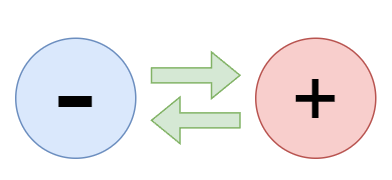
The main thing to know is that charge is a quantifiable property, and it comes in single unit which we scale to Coulombs. Charge is not a physical object.
Protons and electrons are charge carriers. They are objects which have charge but are not charge, because charge is something you have, and not something you are.
Most misconceptions come from thinking that current and voltage are about electrons, and not charge.
2. Current
Current is the motion of charge. Current is not the motion of protons or electrons or holes or any physical object. It is the motion of charge. Doesn’t matter how it got there. Doesn’t matter if positive charge appeared in place, or negative charge disappeared in another. It’s the motion of charge. In mass spectrometry we use ionized gas molecules as part of our current loops. Sometimes they’re positively charge and sometimes they’re negatively charged.
Think of it like money, and debt. You can buy and sell debt. You can invest in stocks, but you can also short them. Negative money going one way is the same as cash going the other way.
Current tracks the motion of charge. Whether the charge is positive or negative doesn’t matter, that will just get tracked by the motion i.e the current. If a positive charge goes one way, that’s positive current in that direction. If negative charge goes that same way, that’s negative current in that direction, which is mathematically equivalent to positive current in the other direction.

So let’s make it explicit: the idea of “charge moves in one way, but current actually moves in the other” is outright not true. It’s not a matter of semantics. Charge and current both move in one way. Charge carriers may move in some other way, but that’s not what electrical current is. It doesn’t matter what charge carriers do. We track the property of charge and the number associated with that, which then we call current.
3. Electrons and Holes
Charge is up, charge is down, positive, negative, directions and polarities. Who cares? Fine, we’ll do it like you say. What are the consequences anyway?
Time to get real. Charge is not the same as charge carriers, but we can’t talk about how charge moves without how charge is actually carried. Matter is not the same as mass, but if you want to keep track of mass it still matters!
I’m going to make a distinction here that some of you may not know which is electrical vs electronic. Electrical is anything with electrical current, but electronic specifically refers to circuits with devices where electricity controls electricity, which allows you to send useful information and not simply power. Sending current through a motor isn’t data, it just goes and sends power and it turns the motor which spins. Sending current through a BJT can be data, it can mean 1’s and 0’s, which get sent down the line and turns into audio. In practice, this pretty much always means semiconductors. Metals like copper are conductors, dielectrics like rubber are insulators, but semiconductors like silicon and germanium are semiconductors.

In metals, the electrons just freely float around like leaves in the wind, and that’s what current is. In semiconductors, atoms and electrons have a more complicated relationship. There are distinct bands, individual cliques and roles that every electron plays.
There’s of course the nucleus, but around the nucleus we have electrons. The outer layer used for bonds between atoms is called the valence band. Then above that we have the “conduction band”, which is where electrons are far away enough the nucleus that they can be pushed around. When an electron is injected with energy, it jumps up from the valence band to the conduction band and leaves behind an empty “hole.”

In the (greatly simplified) graphic above, is a silicon atom which has a nucleus, a few electrons in the lower layers, and then the valence band which can contain up to 4 electrons. However here one of the valence electrons has enough energy to be in the higher band, the conduction band, which leaves a spot open in the valence band.
When we know an electron could be in the valence band but isn’t, we can track that. We can track empty seats in a stadium. When an electron moves up, over, and down into a vacancy in that other atom’s valence band, rather than thinking of the electron moving we can think of the vacancy moving.
That’s why we have different electron and hole “mobilities”. Because for electrons to move around in the conduction band, they just have to move over one, but for holes to move, an electron has to create a hole and then jump over all the way to another atom and take another hole’s spot.
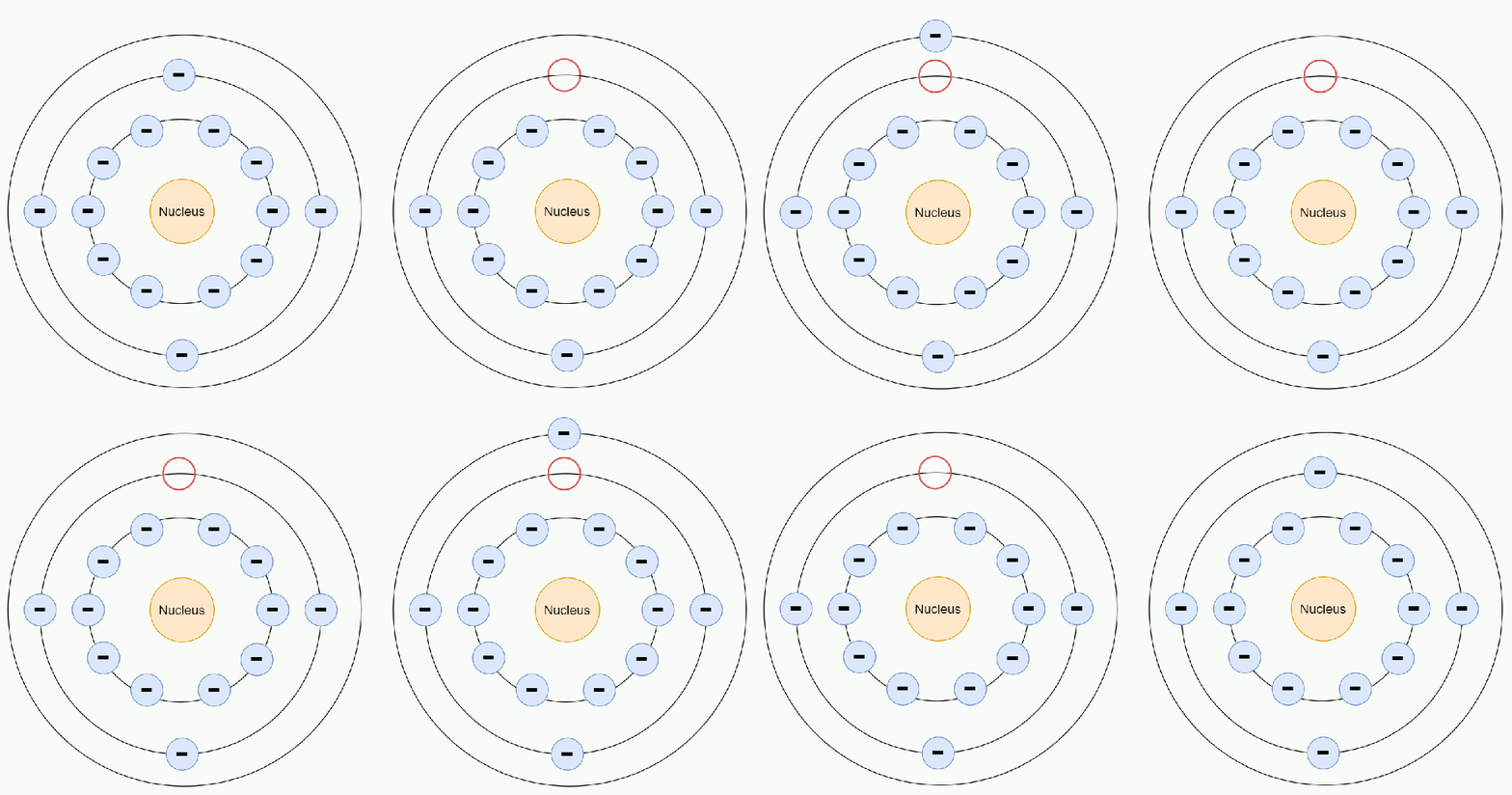
See how the electron and hole on the right side switch spots? Since holes are the opposite of electrons, that means they have positive charge, and wherever they move is positive current, so in semiconductor electronics that’s what current is even if it is really the electrons movie as charge carriers.
Hope that clears up the confusion of current and charge!
 Positive Feedback